StayFocusd Alternatives That Keep Your Browsing Data in the Browser
What a May 2026 analysis documented about StayFocusd's data practices, and local-first blockers — LeechBlock NG, Cold Turkey, BrowseWell — to consider.
In May 2026, independent researcher James Arnott documented that StayFocusd — the long-running free blocker published by Sensor Tower — sends "almost every URL you visit" out of the browser, while its store listing promises it doesn't collect personal data from the pages you visit. The extension is still listed and still works as a blocker; but if the reason you're here is that you want your browsing data to stay on your machine, there are solid local-first alternatives: LeechBlock NG (free), Cold Turkey (desktop, one-time purchase), and BrowseWell (browser-native, no account).
First, what was actually documented — precisely, with dates — because the coverage floating around ranges from careful to overheated, and you deserve the careful version.
What was documented, and when
- December 28, 2025 — John Tuckner of Secure Annex identified StayFocusd as containing prompt-poaching code: infrastructure for scraping AI-chat conversations.
- January 6, 2026 — The Hacker News covered AI-chat-scraping extensions and named Sensor Tower's StayFocusd in its prompt-poaching reporting.
- May 11, 2026 — James Arnott published his "AI Chat Scraper Wall of Shame" (documented on consumerrights.wiki and amibeingpwned.com), based on sandboxed dynamic and static analysis with manual verification. He classified StayFocusd — roughly 600,000–700,000 users depending on the source — as "Capability." In his tier system, that means the AI-chat exfiltration code and remote endpoints are present and functional, but did not activate during his observation, which he attributes to server-side gating. Separately, his analysis documents the extension sending "almost every URL you visit" off the browser, with PII filtering that exists but is US-centric — a whitelist built around adult sites and US health domains, and US-format regular expressions.
- May 15, 2026 — the Chrome Web Store listing (then v4.5.13) simultaneously advertised "Gen AI Analytics: Track and analyze your usage of AI chat platforms directly from the StayFocusd" (sic) and "Privacy protection: StayFocusd does not collect personal data from the web pages you visit."
Two caveats that the louder coverage tends to drop, and that Arnott himself carries:
- The AI-chat scraping was not observed active. "Capability" means the code is there and works, not that it was seen running against users. Because the infrastructure is gated server-side, absence of observed activation doesn't establish that none occurs — and equally, it was not observed occurring. Both halves of that sentence matter.
- The URL collection, by contrast, was directly documented. Per Arnott's analysis, the URL-level data leaving the browser is not a hypothetical.
No response from the publisher is documented in these sources as of this writing. If Sensor Tower publishes one, it belongs in this picture.
Where StayFocusd stands today
StayFocusd remains on the Chrome Web Store — v4.6.6 as of a July 9, 2026 update, roughly 700,000 users, a 4.44-star rating across 8,738 ratings, published by "ST Pulse" (a Sensor Tower company). Its privacy notice still states: "we will never collect personal data from the web page content that you are browsing."
Fairness requires saying two things at once. StayFocusd spent over a decade as a genuinely useful free blocker — time limits per site, the famous Nuclear Option — and those blocking features still function today. The documented concern is about where its data goes, not whether its features work. Whether that concern moves you is a personal call; the rest of this page is for readers who've decided it does.
What to look for in a replacement
The checklist that falls out of this episode is short:
- Where does the data live? "Local-first" means your browsing activity stays on your machine. Cloud sync is a different model — sometimes worth it, but it should be a choice you notice making.
- Who is the publisher? A named developer or company whose business model you can state in one sentence.
- What does the listing declare — and is it internally consistent? The May 15 listing language above is exactly the pattern to check for.
- Does it require an account? Every account is a channel your data could travel through. For a site blocker, none is needed.
Local-first alternatives, by fit
LeechBlock NG — free and open source, and the closest feature match to StayFocusd's model: per-site time limits and deeply configurable rules. Being open source means the "what does it do with my data" question is answerable by anyone who cares to look. Best for: replicating StayFocusd's time-limit workflow at zero cost.
Cold Turkey — a desktop application (Windows and macOS) rather than an extension, so its blocks apply across every browser and, in the Pro version, to desktop apps too. Pro is a $39 one-time purchase; a free version covers website blocking with timed blocks. Best for: hard blocks that survive "I'll just open a different browser." Full breakdown in BrowseWell vs Cold Turkey.
Freedom — the cross-device option: scheduled sessions across macOS, Windows, iOS, and Android, at $8.99/month, about $40/year, or a $99.50 lifetime as listed in July 2026. One thing to say neutrally: Freedom is account-based and cloud-synced — that's what makes cross-device blocking work, and it's a different privacy model than local-first. If your priority is blocking on your phone too, that trade may be worth it; go in knowing you're making it. More in BrowseWell vs Freedom.
BrowseWell: the local-first answer, by architecture
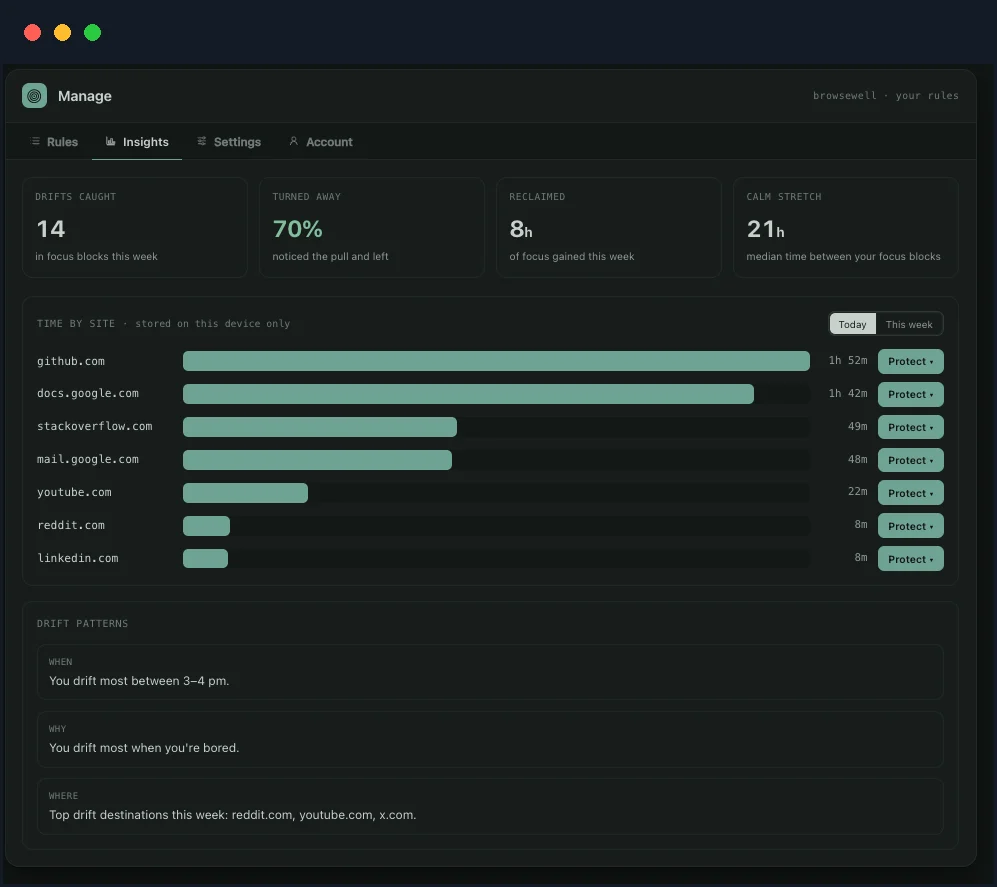
The insights view says it on the label: stored on this device only. There is no server to send browsing data to.
BrowseWell belongs to the category this whole episode argues for: extensions built so browsing data stays in the browser. It's local-first by design: no account at install or trial, and browsing data stays in the browser rather than traveling to anyone's server. That's not a virtue claim about the publisher — it's an architecture that shrinks what you have to trust.
On the actual blocking job, BrowseWell covers StayFocusd's territory differently. Instead of countdown timers, habitual sites become Intentional Sites: the site opens after you state what you're there to do, for a bounded access window. You can guard whole domains, single pages, or path sections — reddit.com/r/popular without losing the subreddits you work in (worked example here) — and optional Hard Mode adds friction so bypassing a rule is deliberate rather than reflexive. If rigid timers are part of why you're shopping around at all, that difference is covered in the best site blockers for ADHD brains.
It's paid — $9/month, $67/year, or $197 lifetime — with a 30-day full-access trial, no card and no account required. If local-first plus intent gates sounds like your shape, start the 30-day free trial.
Side by side
| LeechBlock NG | Cold Turkey | Freedom | BrowseWell | |
|---|---|---|---|---|
| Browsing data lives | In the browser | On your computer | Cloud-synced account | In the browser |
| Price | Free, open source | $39 one-time (Pro); free version | $8.99/mo, ~$40/yr, $99.50 lifetime | $9/mo, $67/yr, $197 lifetime |
| Platform | Browser extension | Windows, macOS (all browsers) | Cross-device incl. mobile | Chrome |
| Blocking model | Per-site time limits, configurable rules | Hard blocks, schedules, app blocking | Scheduled sessions, Locked Mode | Path guards, intent gates, bounded windows |
| Account required | No | No | Yes | No |
Competitor pricing as listed on each product's site, July 2026.
If you take one thing from this page: the lesson of May 2026 isn't "StayFocusd bad." It's that for a tool whose entire job is watching which sites you visit, where that information lives is a first-order feature — worth checking as deliberately as you'd check the price.